

- The College Transparency Act could give families better college cost and outcome data.
The bipartisan proposal would make it easier to compare tuition, financial aid, graduation rates, student debt, and earnings after graduation. - Cuts to the National Center for Education Statistics have weakened a critical source of college data.
Major staffing reductions and canceled research contracts have created concerns about delays, reliability, and the future of federal higher-education reporting. - Parents should cross-check multiple sources before choosing a college.
Use each school’s Net Price Calculator and Common Data Set, along with state databases, and direct questions to the college about scholarships, graduation rates, debt, and earnings by major.
College planning should start with facts.
Not rankings. Not a glossy brochure. Not a campus tour where every student supposedly graduates in four years, lands a great job, and spends Saturday afternoons tossing a Frisbee under a perfectly blue sky.
Parents need real numbers.
What will this college actually cost our family? How much scholarship money does the school typically provide? What percentage of students graduate? How much debt do families take on? And what are students earning after they graduate, particularly in the major my student is considering?
These are not small questions. For many families, college will be one of the largest purchases they ever make, right alongside buying a home and saving for retirement.
You deserve good information before making that decision.
A Big Step Forward, But Not a Finished Solution
On July 30, 2026, the Senate Health, Education, Labor and Pensions Committee voted 21 to 1 to advance the bipartisan College Transparency Act.
That is encouraging. But it is important to understand that the bill has not yet passed the full Senate or become law.
If enacted, the College Transparency Act would create a new student-level data system designed to provide better information about enrollment, college costs, financial aid, graduation rates, and earnings after college, including results across different colleges and majors. (Senate HELP Committee)
To me, that is exactly the kind of information families need.
The question should not simply be, “Can my student get into this college?”
The better questions are: What will it cost? What will we need to borrow? What are the likely outcomes? And does this decision fit our goals and values around what we want our dollars to do for us?
That is what should drive your decisions.
Families Are Asking Colleges to Prove Their Value
The push for better information comes at a time when confidence in higher education has fallen again.
According to 2026 Gallup research reported by the Lumina Foundation, only 38% of Americans say they have a great deal or quite a lot of confidence in higher education. Among those who lack confidence, the most common concerns include campus political agendas, the cost of college, and whether schools are properly preparing students for the workforce. (Lumina Foundation)
I do not think that means families have given up on college.
I think it means they are becoming more careful consumers.
Families still believe education can create opportunity, open doors, and help students build successful careers. But they also want confidence that the money they are spending and borrowing is going to produce a reasonable outcome.
That matters.
The Federal College Data System Has Been Disrupted
Unfortunately, the effort to improve college information is happening while the federal education research system is dealing with major staffing and funding disruptions.
The National Center for Education Statistics is the federal agency responsible for collecting and publishing much of the information families, colleges, researchers, and policymakers use to understand education in America.
In March 2025, all but three of the agency’s 102 employees were terminated. Some staffing was later restored, but a bipartisan group of senators reported in May 2026 that NCES still had only about 11 employees, compared with roughly 100 before the reductions.
The administration also canceled nearly $900 million in Institute of Education Sciences contracts in 2025. Some contracts were later restored or revised, but the disruption affected research projects, publications, data systems, and the people responsible for keeping those systems running. (Inside Higher Ed)
As of May 2026, a bipartisan group of 19 senators was also pressing the Department of Education to release approximately $290 million in remaining research funding before some of that money expired. (K-12 Dive)
So yes, there is a real problem.
But I would not describe it as a complete data blackout. Federal tools such as College Scorecard, College Navigator, and IPEDS are still available. The issue is that families need to understand the limitations of those numbers and cross-check what they find.
Where Families Can Find Reliable College Data Right Now
Start With the College’s Net Price Calculator
Most colleges that participate in federal student aid programs are required to provide a Net Price Calculator on their website.
The calculator estimates what a family like yours might pay after grants and scholarships are subtracted from the school’s total cost of attendance.
Search the college’s name followed by “Net Price Calculator.”
Do not stop at the advertised tuition. Include housing, meals, fees, books, travel, and personal expenses. And remember that a net price estimate is not a financial aid offer. It is a starting point.
Run the calculator for every serious college on your student’s list.
Find the School’s Common Data Set
Many colleges publish a Common Data Set through their institutional research or planning office.
Search the name of the college followed by “Common Data Set” or “Institutional Research.”
The Common Data Set can provide information about:
- Admissions and acceptance rates
- SAT and ACT score ranges
- Annual expenses
- Need-based financial aid
- Merit scholarships
- Average financial aid awards
- Class sizes
- Graduation and retention
- The importance of different admissions factors
The Common Data Set is designed to make information more consistent and comparable across participating institutions.
Pay particular attention to the financial aid section. It can help you understand how many students receive institutional aid, how much aid they receive, and whether the school provides merit scholarships to students without demonstrated financial need.
That information can completely change how you build a college list.
Continue Using College Scorecard and College Navigator
College Scorecard and College Navigator are still useful.
College Navigator provides institution-level information reported through the federal IPEDS system. College Scorecard includes information about costs, graduation, student debt, earnings, and outcomes for certain fields of study. (National Center for Education Statistics)
But understand the limitations.
For example, much of the College Scorecard’s student-outcome information has historically focused on students who received federal financial aid. Traditional federal graduation-rate measurements may also focus on first-time, full-time students, leaving out many transfer students, part-time students, and students who did not receive federal aid. Those are some of the gaps the College Transparency Act is intended to address. (Higher Ed Dive)
Use the data. Just do not treat one number from one website as the final word.
Check State Higher-Education and Workforce Data
State higher-education agencies can provide valuable information about public colleges and universities, including enrollment, tuition, graduation rates, transfer outcomes, and sometimes employment and wage information.
For Ohio families, that may include information from the Ohio Department of Higher Education and state workforce databases.
State information can be particularly helpful when comparing public universities, community colleges, transfer pathways, and in-state employment outcomes.
Ask the College Better Questions
Families should also ask the college directly:
- What percentage of students in this major graduate within four years?
- How many students change out of this major?
- What is the job placement rate, and how is it calculated?
- Are salary figures based on all graduates or only those who responded to a survey?
- How many students complete paid internships?
- Is institutional scholarship money renewable for all four years?
- What GPA must the student maintain?
- Does the scholarship increase when tuition increases?
- What percentage of students lose their scholarship?
Do not be afraid to ask for the numbers behind the marketing claims.
You are the consumer.
The Bottom Line for Parents
You need to understand YOUR out-of-pocket cost, and YOUR total student loan debt for all four years. Not just the average. I feel pretty strongly that families should not make a six-figure college decision based on a ranking, a campus visit, or the hope that everything will somehow work itself out.
Cross-check your sources.
Use the school’s Net Price Calculator. Review its Common Data Set. Look at College Scorecard and College Navigator. Check state data. Ask what students in the actual major are earning and how many are graduating on time.
And then bring all of that information back to your family’s goals and values.
The most affordable college is not automatically the right college. The college with the highest ranking is not automatically the right college either. The right choice is the one that gives your student a strong opportunity while allowing your family to make smart money moves, protect retirement, and sleep easy at night knowing you made the decision with your eyes wide open.
It’s not just investments.
It is deciding what you want your dollars to do for you and making sure your college plan fits alongside everything else you are trying to accomplish.
Get Your FREE College Money Report™
The Capstone Team will help you compare your options, identify smart payment strategies, and build a plan that gives your family confidence before the college bills begin arriving.
We can help you understand your opportunities for need-based and scholarship aid:
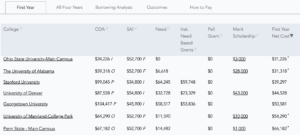
And understand your 4-year net cost, budget, funding gap, loans, and loan payment:
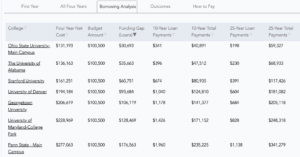
Have more questions? Schedule a conversation with the Capstone Wealth Partners team.