

-
Protect Your Retirement First: Always prioritize your emergency fund and retirement savings before college funding—while your student can borrow for college through federal loans, you cannot borrow for retirement
-
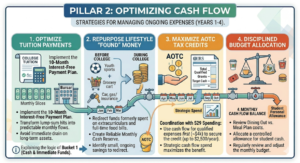
Unlock “Hidden” Cash Flow: Redirecting regular monthly spending on your teenager (like sports fees, entertainment, and clothes) into a university’s 0% interest monthly payment plan can free up thousands in free money over four years, drastically reducing your reliance on loans
-
Know Before You Go: Establish a comprehensive four-year college budget covering all eight semesters down to the penny before you sign a deposit check or tour campuses to ensure your student graduates on time without burdensome debt
With average costs reaching nearly $40,000 per year for four-year institutions and elite universities exceeding $90,000, paying for college isn’t going to get less expensive anytime soon.
When it comes to footing the college bill, too many parents approach this expense one semester at a time, muttering the most dangerous phrase in college planning: “If you get in, we’ll figure it out.” This is not the way to do it. Your family needs a plan.
The good news is that, with a little forethought and analysis of your family’s financial picture, it’s still possible to pay for college without having to guess the price or drain your life savings. By combining strategic cash flow management, smart asset timing, and a clear budget before you shop, you can pay the college bill down to the penny by following my advice below.
Prioritize Retirement First
Before putting a single dollar toward college bills, evaluate your broader financial foundation. College savings should never compromise overall family financial security.
-
The Retirement Reality: You and your child can borrow money for college through federal or private loans, but nobody will lend you money for retirement.
-
Foundation First: Ensure your emergency fund is intact and retirement contributions are on track before over-funding college accounts.
“Know Before You Go” (Take Control of the Budget)
Before your student heads out on college tours and begins the application process, establish a clear financial budget.
Map out all available parent resources (529 savings, liquid assets, cash flow) and student resources (earnings, direct loans) ahead of time. When you know your family’s exact budget before shopping, you can target schools that offer strong academic fit alongside generous merit aid and financial assistance.
You can also use my FREE College Money Report to discover all the scholarships and free money available to your student at any school in the country.
Understand the “3 Money Buckets”
To fund higher education efficiently, families draw from three primary financial sources.
-
Savings: 529 plans, mutual funds, stocks, and dedicated savings accounts.
-
Cash Flow: Ongoing monthly income redirected from current family spending.
-
Loans: Federal Direct loans, Parent PLUS, or private student loans (which should ideally be minimized).
Most families focus heavily on accumulated savings and immediately turn to heavy borrowing to fill any remaining gap. The key to reducing loan dependency is mastering the middle bucket: Cash Flow.
Unlock Your “Hidden” Monthly Cash Flow
Many parents assume cash flow stops once a student leaves for college. In reality, you are likely spending $400, $500, or more every month on your high school teenager for sports, gas, clothing, food, and activities.
-
The $19,000 Realization: Redirecting $400 per month of existing teenage spending toward college costs yields $19,200 over four years in “found money.”
-
0% Interest Monthly Installment Plans: Rather than taking out expensive loans to pay a lump sum each semester, enroll in the university’s 0% interest monthly payment plan. Using redirected monthly cash flow to pay as you go directly reduces your borrowing needs.
Apply the 4 Pillars of Smart Payment Strategy
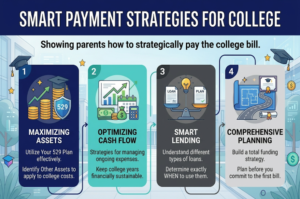
If you want to hear me go even more in depth about college payment strategies, watch Smart Payment Strategies for College. This webinar discusses how you can:
-
Maximize Assets: 529 funds grow tax-deferred and come out tax-free for qualified education expenses. Time distributions within the same calendar year as expenses and coordinate with tax credits like the American Opportunity Tax Credit (AOTC).
-
Maximize Cash Flow: Combine redirected teen expenses with part-time student earnings and monthly college payment plans.
-
Develop Smart Lending Strategy: Use Federal Direct Subsidized and Unsubsidized student loans first (capped at $27,000 total over four years). Keep total student borrowing under the student’s expected first-year starting salary after graduation (roughly $100/month in payments for every $10,000 borrowed over a 10-year term).
-
Develop A Comprehensive 4-Year Plan: Build a complete four-year roadmap covering all eight semesters before signing the first deposit check.
Frequently Asked Questions (FAQs)
1. Should I prioritize saving for my child’s college education or my own retirement?
Your retirement savings and emergency fund should always take priority over college savings. While your child can utilize federal student loans, grants, scholarships, and income to fund their education, there are no loans or financial aid options available for your retirement. Protecting your financial health ensures you won’t need to rely on your children financially later in life.
2. How does a college monthly payment plan work, and how can it reduce loans?
Most universities offer 0% interest monthly installment plans that spread each semester’s tuition and housing costs across 4 to 5 monthly payments instead of requiring a lump sum upfront. By redirecting money you currently spend on your high school student—such as sports fees, extracurriculars, clothing, and daily expenses—into a monthly payment plan, you can cash-flow a significant portion of the bill and avoid taking on extra loans.
3. How much student loan debt is considered responsible for a student to take on?
A safe benchmark is to cap total student loan borrowing across all four years at or below the student’s expected first-year starting salary after graduation. As a general rule of thumb, every $10,000 in student loans translates to roughly $100 per month in loan repayments over a standard 10-year term. Keeping total borrowing manageable ensures post-graduation payments remain within a realistic budget.
4. Can I use a 529 plan and still claim the American Opportunity Tax Credit (AOTC)?
Yes, but you must coordinate your withdrawals carefully. The IRS prohibits “double-dipping,” meaning you cannot pay for the exact same tuition dollars using both tax-free 529 funds and the AOTC. To maximize your benefits, pay at least $4,000 of qualified tuition out of pocket (or from non-529 accounts) to capture the maximum $2,500 AOTC credit, and use your 529 plan for remaining eligible expenses like room, board, and books.
Schedule Your Meeting With Me
If you have more questions about paying the college bill and would like to have a Certified College Financial Consultant review your family’s college planning and payment outlook, schedule a 30-minute complimentary session with me.