

-
The Scholarship Numbers Game: Fewer than 2% of high school athletes receive an athletic scholarship, and only ~1% get a full ride. Relying solely on athletic aid is a risky strategy—academic merit and need-based aid remain the most reliable funding sources.
-
The New Division I Rules: DI sports have shifted from traditional scholarship caps to sport-by-sport roster limits alongside direct school revenue-sharing (up to $20.5M+ per school). However, schools are not required to fully fund every roster spot, making athletic department budgets vary wildly.
-
NIL Is a Business (With Tax Realities): Earning Name, Image, and Likeness (NIL) income turns student-athletes into independent contractors. NIL money is taxable (requiring 1099 filings) and can directly impact federal need-based financial aid (FAFSA) eligibility.
Parents of future college athletes need to know they are stepping into a college athletics landscape that looks radically different than it did two years ago.
Between historic legal settlements, direct school revenue sharing, the elimination of traditional scholarship caps in favor of roster limits, the NCAA Transfer Portal, and evolving Name, Image, and Likeness (NIL) rules, navigating athletic recruiting can feel like trying to hit a moving target.
Here is your updated guide to understanding the real numbers, the latest rules, and how to build a financially smart recruiting strategy for your student-athlete.
The Hard Numbers: Realistic Odds in College Sports
Before diving into recruiting tactics, let’s ground you in reality. Every parent wants to believe their child will earn a full athletic scholarship, but the data tells a sobering story:
-
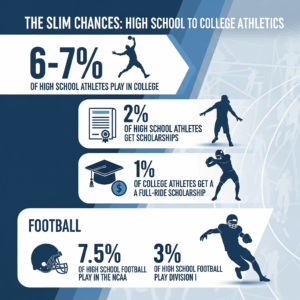
Overall Participation: Only 6% to 7% of high school athletes go on to compete at the college level across all divisions (NCAA Division I, II, III, NAIA, and Junior Colleges).
-
Athletic Aid Rates: Only about 2% of high school athletes receive any form of athletic scholarship.
-
The “Full-Ride” Myth: Only about 1% of college athletes receive a true “full-ride” athletic scholarship. The vast majority of athletic aid is offered as partial scholarships (e.g., covering 25%, 50%, or 75% of tuition).
-
Football & Major Sports: While sports like football draw high media attention, only ~7.5% of high school football players play in the NCAA, and just 3% make it to the Division I level.
The Golden Rule for Parents: Hope is not a strategy. Betting your family’s college funding plan strictly on an athletic scholarship is an extreme risk. Academic merit, need-based financial aid, and smart college selection must remain the foundation of your plan.
NCAA Division Breakdown & The New “Roster Limit” Era
Historically, NCAA sports operated under strict scholarship caps per sport (for example, DI Baseball was limited to 11.7 scholarships split among up to 32 players). Following the landmark House v. NCAA court settlement, the landscape shifted dramatically:
Division I (DI)
-
The New Roster Cap Structure: Traditional scholarship limitations have been replaced by sport-by-sport roster caps. For instance, baseball roster limits expanded to 34 players, football to 105, and women’s soccer to 28.
-
Full Roster Funding Potential: Schools are now legally allowed to offer full scholarships to every athlete on an expanded roster up to the limit. However, schools are not required to fund every spot. Athletic departments still operate within budgets, meaning scholarship availability varies wildly between Power Four programs and mid-major DI schools.
-
Ivy League Exception: Ivy League DI schools continue to offer ZERO athletic scholarships, funding education strictly through non-athletic, need-based financial aid.
Division II (DII)
-
Division II continues to offer partial athletic scholarship models (“equivalency sports”), emphasizing a balance between high-level athletics, academic rigor, and campus community engagement.
Division III (DIII)
-
Division III schools do not offer athletic scholarships. However, DIII schools remain one of the most financially advantageous paths for student-athletes. Over 80% of DIII student-athletes receive merit-based or need-based financial aid. DIII student-athletes often enjoy higher graduation rates and robust academic outcomes.
Revenue Sharing, Third-Party NIL & The Transfer Portal
College athletics has officially entered a professionalized era. Parents must understand three distinct mechanisms shaping recruiting today:
Direct Revenue Sharing (The House v. NCAA Settlement)
-
School-to-Athlete Payments: DI athletic departments that opt into the revenue-sharing model can distribute up to $20.5 million+ annually directly to student-athletes (a cap set to increase annually).
-
Priority Sports: While revenue sharing covers all sports, the majority of these funds flow directly to high-revenue sports like football and basketball.
Third-Party Name, Image, and Likeness (NIL)
-
Athletes can monetize their personal brand through local business endorsements, social media campaigns, coaching clinics, and autographs.
-
Fair Market Value & “NIL Go” Oversight: Third-party NIL deals over $600 must be disclosed and screened by designated clearinghouses (such as NIL Go) to ensure they reflect true Fair Market Value (FMV) rather than hidden recruiting inducements.
The NCAA Transfer Portal Impact on High School Recruits
-
Rules allowing athletes to transfer multiple times without sitting out a year have fundamentally changed roster management.
-
College coaches now reserve a significant portion of their roster spots and scholarship budgets for experienced college transfers rather than incoming high school seniors. High school recruits must be proactive, targeted, and realistic in their outreach.
Rules for Traditional NIL Agreements
The rules for NIL are complex and can vary by state and university. It’s a decentralized system with a few key principles:
- Not a salary: NIL is not a salary paid by the school for an athlete’s performance. The school itself cannot be directly affiliated with the NIL deal.
- Disclosure is key: Athletes are now required to disclose their NIL deals to their university.
- Recruiting prohibitions: Deals cannot be used as a direct inducement to recruit a prospective student-athlete to attend a particular school.
- State laws: You must be mindful of the laws in the state where your student-athlete’s college is located, as some states have prohibitions on deals with certain industries like alcohol or gambling.
What Parents Need to Know: Financial, Tax, and Legal Realities
If your child receives NIL income or direct revenue-sharing payments, they are no longer just a student-athlete—they are an independent contractor/business owner.
-
Taxes & Form 1099: NIL income is taxable income. Student-athletes receiving $600 or more from a collective or sponsor will receive a Form 1099. They must set aside 25%–30% of earnings for federal, state, and self-employment taxes.
-
FAFSA & Financial Aid Impact: NIL earnings count as student income on the Free Application for Federal Student Aid (FAFSA®), which could reduce eligibility for need-based financial aid in subsequent years.
-
Contract & Intellectual Property Protections: Deal terms must be reviewed carefully to ensure your child isn’t signing away their long-term name/likeness rights or violating team/university sponsorship guidelines.
- Student-Athlete’s Rights: It’s the student-athlete who owns the rights to their own NIL, and they are the one who enters into the agreements. However, as with any major life decision, the involvement and guidance of a parent is invaluable.
- Seek Professional Advice: NIL deals can be complex business and legal agreements. Many athletes and their families lack the expertise to navigate these deals, understand the tax implications, or manage the new income. Seeking professional advice from a financial advisor or an attorney with experience in NIL is highly recommended. These professionals can help with:
- Tax planning: Understanding and preparing for the taxes that will be owed on NIL income.
- Contract review: Ensuring the terms of a deal are fair and protect the athlete’s interests.
- Budgeting and investment: Creating a plan for managing and growing the income they earn.
- Branding: Helping them build a sustainable personal brand that extends beyond their college career.
Action Plan for Parents: How to Win the Recruiting Game
-
Prioritize the “Un-Injured” Test: Ask your child, “If you suffered a career-ending injury tomorrow, would you still love attending this school?” Choose schools based on academic fit, culture, and career outcomes first.
-
Target Academic Merit Aid: Academic scholarships are far more plentiful and stable than athletic aid. A high GPA and test score open doors to merit packages that stack with athletic offers.
-
Be Proactive in Communication: Don’t wait for scouts to find your child. Create a concise highlight reel, keep an updated athletic/academic resume, and reach out directly to assistant coaches and recruiting coordinators.
-
Get Professional Guidance: Consult with a college financial planner and tax professional who understands athletic aid, FAFSA calculations, and NIL tax strategies before signing national letters of intent or endorsement contract
Frequently Asked Questions
How do the new NCAA roster rules and direct payments work?
Following the House v. NCAA settlement, Division I schools can directly share up to $20.5M+ annually in revenue with student-athletes. Additionally, traditional scholarship caps per sport have been replaced by strict team roster limits (e.g., 105 for football, 34 for baseball). While schools can offer full scholarships to everyone on the roster, funding depends entirely on each university’s athletic budget.
Does Name, Image, and Likeness (NIL) income affect taxes or financial aid?
Yes. NIL deals and revenue-sharing payments count as taxable self-employment income (requiring Form 1099 filings for earnings over $600). Because NIL earnings are reported as student income on the FAFSA®, high earnings can significantly lower your student’s eligibility for traditional need-based financial aid.
Do Division III schools offer athletic aid, and are they still worth considering?
DIII schools do not offer athletic scholarships, but they remain one of the best financial paths. Over 80% of DIII student-athletes receive merit- or need-based aid, often resulting in net costs comparable to—or lower than—partial Division I or II athletic offers.
How does the NCAA Transfer Portal impact incoming high school recruits?
Because college athletes can transfer with immediate eligibility, college coaches increasingly use the transfer portal to fill immediate roster needs with proven college talent. This has delayed high school recruiting timelines and increased competition for incoming freshmen, making early, proactive outreach and a broad school list more critical than ever.
For a closer look at how roster adjustments and portal trends shape options for high school players, check out Transfer Portal Impact on NCAA Recruiting. This video breaks down how college programs are balancing transfer portal commitments with high school recruiting strategies.
If you want to talk more about getting your student-athlete in and through college, please feel free to schedule a complimentary meeting with me. In the meantime, you can also receive your free College Money Report™ to see how much financial aid your student will be eligible for.