

Is your student obsessed with the romanticism of international student life? Who wouldn’t want to spend their weekends exploring the cafes of Paris, riding bullet trains through Tokyo, or studying in centuries-old libraries in the UK? Sending a child abroad for a full undergraduate or graduate degree can be a thrilling, life-altering alternative to the standard American college campus.
But as the acceptance letters arrive and reality sets in, the conversation naturally shifts from packing lists to financial logistics, and parents have to ask, “How do we pay for our student’s dream?”
The good news is that if you have a College 529 savings plan, that money can fund an international college education!
Can we use our hard-earned 529 college savings funds to pay for a university outside the United States? However, it is not a blanket approval for every school or every expense. To keep your 529 withdrawals 100% tax-free and avoid painful IRS penalties, you have to know the ground rules of global educational investing.
Navigating the Rules of 529 Global Funding
Using your 529 plan abroad successfully requires balancing two distinct sets of criteria: where the money goes and what it actually buys.
The Golden Rule of School Eligibility
To withdraw your savings tax-free, the international university must be classified as an eligible educational institution by the U.S. Department of Education. Specifically, the school must participate in the U.S. Federal Student Aid (Title IV) program and possess an official Federal School Code.
Currently, there are hundreds of eligible foreign universities worldwide, spanning popular destinations like the UK, Canada, Australia, France, and Germany.
But be warned: never assume an international school is eligible based purely on its global prestige or historic reputation. Some incredibly well-known foreign universities choose not to participate in the U.S. federal student aid program. If you withdraw 529 funds for an ineligible school, it will trigger standard income taxes plus a 10% federal penalty on your earnings.
Always look up your prospective international school using the Federal School Code search tool on the official StudentAid.gov website before making financial commitments.
What Expenses Are Actually Covered?
Even if the foreign university is fully approved, the IRS strictly regulates what counts as a “qualified educational expense.”
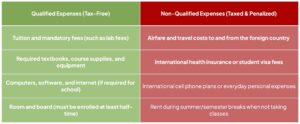
Crucial Room and Board Nuances
If your student chooses to live in an off-campus apartment or student housing abroad, your tax-free 529 spending is capped. It cannot exceed the school’s officially published “cost of attendance” (COA) allowance for housing and food. This is the exact same rule that applies to living off-campus at a domestic U.S. university. Always check the university’s financial aid page to find their exact room and board allowance ceiling.
Other Logistics and Pitfalls
-
The Half-Time Rule: To use 529 money for housing and food, the student must be enrolled at least half-time in a degree-granting program.
-
Currency Fluctuations & Wire Fees: 529 plan administrators typically payout in U.S. Dollars (USD) via paper check or domestic electronic transfer. Converting those funds into Euros, Pounds, or Canadian Dollars means you will be exposed to fluctuating exchange rates and potential international wire transfer fees.
-
The Calendar Year Match: Always ensure you withdraw the funds from your 529 plan in the same calendar year that you actually pay the university bills. Timing mismatches between semesters are a major trigger for IRS audits.
-
State Tax Laws: While the federal government allows tax-free international withdrawals, a handful of U.S. states have unique laws. Check with your specific state’s plan administrator to ensure they don’t claw back state tax deductions or credits for funds sent outside the country.
Beyond the Bucks: Is Your Student Ready?
As any Independent Educational Consultant (IEC) will tell you, a successful college experience abroad requires a currency far more valuable than dollars or euros: emotional maturity and independence.
Experts across the field, including the Independent Educational Consultants Association (IECA), emphasize that finding a “best-fit” school abroad hinges on assessing a student’s baseline resilience. Overseas, the learning curve outside the classroom is often much steeper than the one inside it.
If you are trying to gauge whether your child is ready to take the leap, look beyond their GPA and evaluate them against this “Real World” Readiness Checklist:
-
Navigating the Unknown: In the U.S., many students rely on a car or a predictable campus bubble. Abroad, your student will likely be entirely dependent on intricate public transit systems. Can they figure out a complex train grid, and—more importantly—handle getting on the wrong train without panicking?
-
Leaping Over Language Barriers: Even in an English-speaking degree program, daily life in a country like Germany or the Netherlands requires adaptability. Can your student handle the humility of ordering groceries via Google Translate or communicating with a landlord who speaks minimal English?
-
Fierce Self-Advocacy: Overseas universities generally treat students as independent adults from day one. There are rarely hands-on advisors or “helicopter parent” portals checking in on them. If your student encounters a bureaucratic hiccup with a visa or a housing discrepancy, they must be mature enough to step up and solve it themselves.
Final Thoughts
As parents, your instinct is to smooth out every bump in the road. But when your child is thousands of miles away, you physically can’t—and according to international education experts, that is exactly where the magic happens.
Attending college abroad accelerates a young person’s growth like nothing else. They don’t just graduate with a degree; they graduate with an unshakeable sense of self-reliance. They become global citizens who can land in a brand-new city, respect the cultural nuances, and build a life from scratch.
If your student possesses that spark of curiosity, a healthy dose of adaptability, and the maturity to manage their own life, funding their global education with your 529 plan isn’t just a smart tax strategy—it’s an investment in launching a truly dynamic, resilient human being. Have the open conversations, trust the foundation you’ve built for them, and get ready to watch them fly!