

The deadlines to sign up for the ACT and SAT over the summer and into the fall are approaching, and, as a college financial planning professional, I see families overestimate or underestimate the importance of these standardized tests all the time, and that’s because there’s a lot of misinformation out there.
Ever since the pandemic, the college admissions landscape has been turned upside down, and the phrase “test-optional” has led many families to believe that the ACT and SAT no longer matter. That’s not true at all.
While a solid test score certainly gives your student a better edge at getting accepted, it serves a dual purpose: it is one of the fastest ways to secure significant money in the form of merit scholarships.
The Shift Back to Science: Why Colleges Value the Tests
To understand why test prep is a smart investment, we have to look at why universities are leaning back into standardized testing. Data shows that post-COVID, a staggering 85% to 86% of students enrolling in four-year universities boast an “A” average in high school.
Because of this widespread grade inflation, an unweighted 4.0 GPA doesn’t stand out the way it used to. Admissions officers do not have the time to decipher narrative grading or evaluate wildly differing high school standards without a standardized baseline.
Internal research from institutions like Dartmouth shows that standardized test scores are actually a better predictor of college academic success than high school grades or recommendation letters. As a result, major institutions like MIT, Yale, Brown, Dartmouth, UT Austin, and Ohio State have fully returned to requiring test scores.
Even at test-optional schools, the data is clear: the admission rate for students who submit test scores is often double the rate of those who do not.
The Financial Reality of a High Score
Think of a test score like a credit score when applying for a loan—it gives the institution a highly reliable metric to take a financial chance on a student.
-
The Elite Non-Merit Tier: Schools like Harvard, Princeton, and MIT do not offer merit scholarships at all; they only offer need-based financial aid. If you do not qualify for need-based aid, you need to look elsewhere to shop smart.
-
The Private Merit Tier: Smaller private schools, like the University of Dayton, offer up to $33,000 per year in merit scholarships. If you withhold your test scores, you are far less likely to unlock that top tier of funding.
-
The Public Benchmark Tier: At schools like Ole Miss, bumping an ACT score from a 29 to a 30 can mean an extra $6,000 per year. That is $24,000 over four years saved on a single point increase.
When you look at a $24,000 return on investment, spending a few hundred dollars on test preparation over the summer or fall is entirely worth it. Plus, a major financial win in recent years allows families to utilize 529 college savings plan funds to pay for qualified test prep and academic tutoring services.
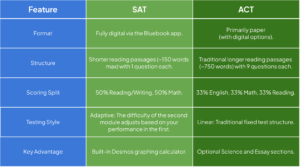
Navigating the Modern Testing Landscape: SAT vs. ACT
The exams have changed significantly over the last two years, making them shorter, more student-friendly, and much easier to pivot between than ever before. Both now take just over two hours to complete.
High-Impact Test Prep Strategies
-
Leverage the Super Score: Almost all colleges now “super score,” meaning they will look across multiple test dates and compile a new composite score using only your highest individual section scores. This removes the pressure of having a perfect test day; students should plan to take the exam 2 to 4 times to maximize their scores before hitting diminishing returns.
-
Review the Math Fundamentals: Neither test covers Calculus. They test how deeply a student understands Algebra I, Geometry, and Algebra II. Advanced math students often struggle because they overthink the questions. Treating the math section like a puzzle based on pattern recognition is the fastest way to improve.
-
Master the Digital Tools: If your student is taking the SAT, they must download the College Board’s Bluebook app and take official practice tests to familiarize themselves with the interface and the built-in Desmos calculator. Knowing how to navigate the platform prevents pacing anxiety on test day.
-
Prioritize the Fundamentals of Performance: High schoolers are notoriously sleep-deprived, but these exams require active logic, not rote memorization. Ensuring your student gets adequate sleep leading up to the exam and encouraging recreational reading to boost contextual vocabulary will naturally yield higher scores.
- For more helpful strategies, watch the “Decoding College Testing” seminar I held with college test prep expert Brian Stewart of BWS Education Consulting.
Keep the Big Picture in Mind
While the financial upside to great test scores is massive, it’s more important to keep test anxiety from sabotaging your student. This is not a life-or-death scenario. If things do not go perfectly, options abound—including test-optional institutions or starting at a regional branch campus and transferring later.
If you are wondering whether your student’s current target score matches your family’s college funding strategy, schedule some time with me and let’s look at the numbers together. What specific universities is your student currently aiming for?
View this post on Instagram