

The landscape of higher education in 2026 is undergoing a massive contraction. In the news, you may hear it referred to as “The Great Higher Ed Reset.” While the headlines often focus on small, private colleges closing, the reality is that even large public flagship universities are being forced to make “impossible” cuts to entire major programs.
As a parent sending your child off to college, now you must not only consider the reputation and cost of a university, but also whether your child’s major will still be around in the next four years. Below is a breakdown of why this is happening and the specific programs and funding sources being hit.
The Core Drivers of the Crisis
The primary reasons for these closures and cuts are a “perfect storm” of demographic, economic, and political shifts:
- The Demographic Cliff: This is the most significant factor. Following the 2008 financial crisis, birth rates in the U.S. plummeted. Eighteen years later, in 2026, the number of college-age individuals has hit a steep decline, leaving many campuses with more seats than students.
- The “Return on Investment” (ROI) Shift: There is a growing public skepticism toward the value of a degree. Many institutions are now using “Time to Value” metrics — measuring how quickly a graduate earns back the cost of their degree — to decide which majors stay and which go.
- The End of Pandemic Aid: Federal COVID-19 relief funds (HEERF) that acted as a financial “life support” for struggling schools have completely dried up, exposing deep-seated budget deficits.
- Operating Cost Inflation: The cost of maintaining aging physical campuses, insurance, and administrative overhead has outpaced tuition revenue, which many schools can no longer raise without losing more students.
The Impact of Federal Research Funding
Federal funding is the lifeblood of major research universities, and recent shifts have been jarring.
- Discretionary Budget Cuts: Under the current administration’s “Big Beautiful Bill” (2025) and subsequent FY 2026 budget proposals, there have been significant proposed cuts to major agencies. For example, the National Institutes of Health (NIH) faced a proposed 40% reduction, and the National Science Foundation (NSF) saw proposed cuts of over 50%.
- Policy-Based Funding Freezes: Federal agencies have begun withholding or “clawing back” research grants from institutions based on non-compliance with new executive orders regarding DEI (Diversity, Equity, and Inclusion) programs or handling of campus protests.
- Upfront Payment Shifts: The NIH recently transitioned to an “upfront multi-year” payment model. While this sounds beneficial, it has drastically reduced the number of new grants awarded annually, leaving young researchers and graduate students without the “bridge funding” they once relied on.
Examples of Eliminated Programs and Stripped Funding
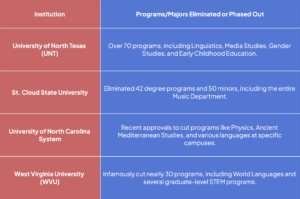
The cuts aren’t just in the humanities; they are hitting STEM and professional programs that were once considered safe.
Examples of Program Eliminations (2024–2026)
Funding Being “Stripped” or Lost
- Case Western Reserve University: Recently saw 8 NIH grants totaling over $3 million terminated under “Departmental Authority,” specifically linked to research involving pandemic delivery changes and social sciences.
- HBCUs and Rural Colleges: Many have lost access to “Supplemental Educational Opportunity Grants” as federal priorities shifted toward vocational and trade-based funding.
- Grad PLUS Loan Caps: New federal legislation effective July 1, 2026, has capped lifetime borrowing for graduate degrees at $100,000. This has effectively “stripped” the funding source for many expensive master’s and PhD programs, forcing universities to shut them down due to a lack of students who can afford them.
Total Institutional Closures
In just the last year, several notable institutions have closed their doors for good due to these combined pressures:
- Birmingham-Southern College (Alabama)
- Fontbonne University (Missouri)
- Wells College (New York)
- Goddard College (Vermont)
It’s a tough time for the “ivory tower.” Many experts believe this consolidation is necessary for the long-term health of the sector, but for the students and faculty in the middle of it, it’s nothing short of a catastrophe.
What This Means for Parents of Students
Entering college in 2026 requires a “investor mindset” rather than just a “student mindset.” With the Great Higher Ed Reset in full swing, you need to ensure the institution isn’t just going to be there for your freshman year, but for your graduation and beyond.
Here is your “Due Diligence” checklist of questions to ask and red flags to watch for.
Questions for the Admissions Office (Institutional Viability)
Admissions officers are trained to be optimistic, so you need to ask for specific metrics rather than “vibes.”
- “What is the university’s ‘Days Cash on Hand’?”
- Why: Healthy private colleges should have 150–250 days; publics should have 90–180. If they have less than 60, they are living paycheck-to-paycheck.
- “What is your ‘Net Tuition Dependency’ ratio?”
- Why: If more than 70% of their budget comes solely from student tuition (rather than endowments, grants, or state funding), they are highly vulnerable to even small enrollment dips.
- “What was the ‘Composite Financial Index’ (CFI) in the last audit?”
- Why: A score of 3.0 or higher is generally considered healthy. A score below 1.0 is a “failing” grade and often leads to federal monitoring.
- “Has the school merged or entered a ‘shared services’ agreement recently?”
- Why: Mergers aren’t always bad, but they signal that the school could no longer survive as a standalone entity.
Questions for the Department Head (Major Viability)
Even at a stable college, individual majors are being cut. Ask these to the people running your specific program:
- “How many tenure-track faculty have been hired in this department in the last 3 years?”
- Why: If the department is relying almost entirely on adjuncts (part-time teachers), the university may be “hollowing out” the program before eliminating it.
- “What is the ‘Time to Value’ for graduates of this major?”
- Why: Ask for the average salary 12 months post-graduation compared to the total cost of the degree. If they can’t provide this data, they aren’t tracking the ROI that modern employers (and lenders) demand.
- “Is this program considered a ‘Margin Producer’ or a ‘Mission Program’?”
- Why: A “Margin Producer” (like Business or Nursing) makes money for the school. A “Mission Program” (like Philosophy or Greek) often loses money but is kept for prestige. In 2026, “Mission Programs” are the first to be cut.
- “Has the curriculum been updated in the last 24 months to include [Industry-Specific Tech/AI]?”
- Why: Stagnant curriculum is a leading indicator that a department is underfunded and at risk.
Red Flags (Your Own Research)
Don’t just take their word for it. Check these three things yourself:
- Deferred Maintenance: Take a walk through the dorms and older academic buildings. Are there “out of order” signs on elevators, peeling paint, or leaky ceilings? Massive deferred maintenance backlogs are often the first sign of a college in a “death spiral.”
- The “Vibe” of the Library: Is the library still buying new books and subscriptions, or are the “New Arrivals” shelves dusty? A library’s budget is often the first “silent cut.”
- Department Enrollment Trends: Look up the college’s IPEDS data (available online). If the number of graduates in your major has dropped by more than 20% over the last five years, that major is on the “chopping block” for 2027 or 2028.
The “Teach-Out” Guarantee
If you are still nervous, ask the registrar: “Does the college have a formal ‘Teach-Out Agreement’ with a nearby institution?” A teach-out agreement is a legal contract that ensures if your college closes, another specific university is required to take you in, transfer all your credits, and let you finish your degree at the same price. If they don’t have one, they aren’t prepared for the worst-case scenario.
Navigating the New Frontier
Ultimately, the “Great Higher Ed Reset” is not just a story of institutional decline, but a fundamental shift in the social contract of American education. The days of choosing a college based on tradition or “the experience” alone have been replaced by a landscape that demands financial literacy and strategic foresight. While these closures and cuts are undeniably painful, they are also forcing a long-overdue transparency in how universities operate and deliver value.
By approaching this transition with an investor’s eye and asking the hard questions now, you can protect your child’s future from the instability of the present. The ivory tower may be shrinking, but for the informed family, a path to a stable and valuable degree is still very much within reach.
If you have more questions about the Great Higher Ed Rest and what this means for your child’s academic future and funding, please schedule some complimentary time with me so I can answer your questions.
View this post on Instagram